Category: Family

  • Youth and Family Peace Day 2025

    By its third year, an annual event either finds its character or it fades. The third annual Youth and Family Peace Day, held on Saturday 8 November 2025 at the Due Drop Event Centre, Sir Robinson Conference Centre, Manukau, found its character — and then some.

    More than 150 participants from across Auckland’s faith and cultural communities gathered under the conviction that had animated the event since its inaugural gathering in 2023: that family building is nation building, and that the most durable foundations of peace are laid not in policy documents or diplomatic agreements, but in the daily life of families who choose to love well.

    Opening Ceremony

    The programme commenced at 1:00 pm with an opening ceremony that carried the warmth and spiritual grounding that has become a hallmark of UPF New Zealand’s events.

    A karakia by Apotoro Shannon Leilua of the Ratana Church opened the gathering — grounding the afternoon in the spiritual inheritance of Aotearoa. The New Zealand national anthem followed, sung together by the assembled community, before Mr. Geoffrey Fyers, UPF NZ Secretary-General, and Mr. Amon Watanabe of FFWPU Youth formally welcomed the gathering and outlined the day’s programme.

    Mr. Kenji Watanabe, UPF NZ Chairman, offered opening remarks that situated the afternoon’s celebration in UPF New Zealand’s ongoing work — the National Family Day Petition, the network of Ambassadors for Peace across Aotearoa, and the conviction that communities like the one assembled at Due Drop are the living proof that a culture of peace is possible.

    Keynote: Family Building is Nation Building

    The keynote address was delivered by Mr. Ross Robertson QSC, AFP — former Deputy Speaker of the New Zealand House of Representatives, long-serving Ambassador for Peace, and one of the most trusted voices in UPF New Zealand’s community. Ross returned to the Youth and Family Peace Day stage with a message as clear and timely as ever: “Family Building is Nation Building.”

    The keynote addressed a truth that sits beneath much of the political and social turbulence of the current moment: that nations are not built primarily by governments, markets, or institutions, but by the families that form the moral and relational substrate of national life. A nation whose families are strong — where children are loved and guided, where spouses are committed and faithful, where the elderly are honoured and cared for — is a nation with reserves of resilience that no government programme can easily replicate.

    Ross spoke with the authority of a man who has spent decades in public life watching what happens when those reserves are depleted — and the conviction of someone who believes it is not too late to rebuild them.

    The LDS Church Manukau Stake added a warmly received musical performance to the opening proceedings, contributing a spirit of joy and community that set the tone for the afternoon ahead.

    A Programme Built for Community

    The afternoon programme drew on the strengths that Youth and Family Peace Day has developed across three years: cultural performances that showcase Auckland’s extraordinary diversity; exhibition tables giving community organisations the opportunity to share their resources; and the informal conversations that happen in corridors and over shared food — often the most meaningful part of any gathering.

    The event brought together participants from Pacific Island, South Asian, East Asian, Māori, and mainstream New Zealand communities — a cross-section of Auckland that rarely finds itself in the same room, and that discovers, each time it does, more common ground than difference.

    Three Years and Growing

    Youth and Family Peace Day has now become one of UPF New Zealand’s most significant annual contributions to Auckland’s community life. From the inaugural event in 2023 — which drew more than 350 people and established the template — to the deepened programme of 2024, and now to the 2025 gathering with its third cohort of participants, the event has grown into something the community can count on.

    Planning is already underway for Youth and Family Peace Day 2026. UPF New Zealand looks forward to welcoming an even broader cross-section of Auckland’s families, faith communities, and civic leaders to what has become one of the most distinctive days in the organisation’s calendar — and one of the clearest expressions of the conviction that drives everything UPF New Zealand does: that peace begins at home.
  • UN International Day of Families 2025

    UN International Day of Families 2025

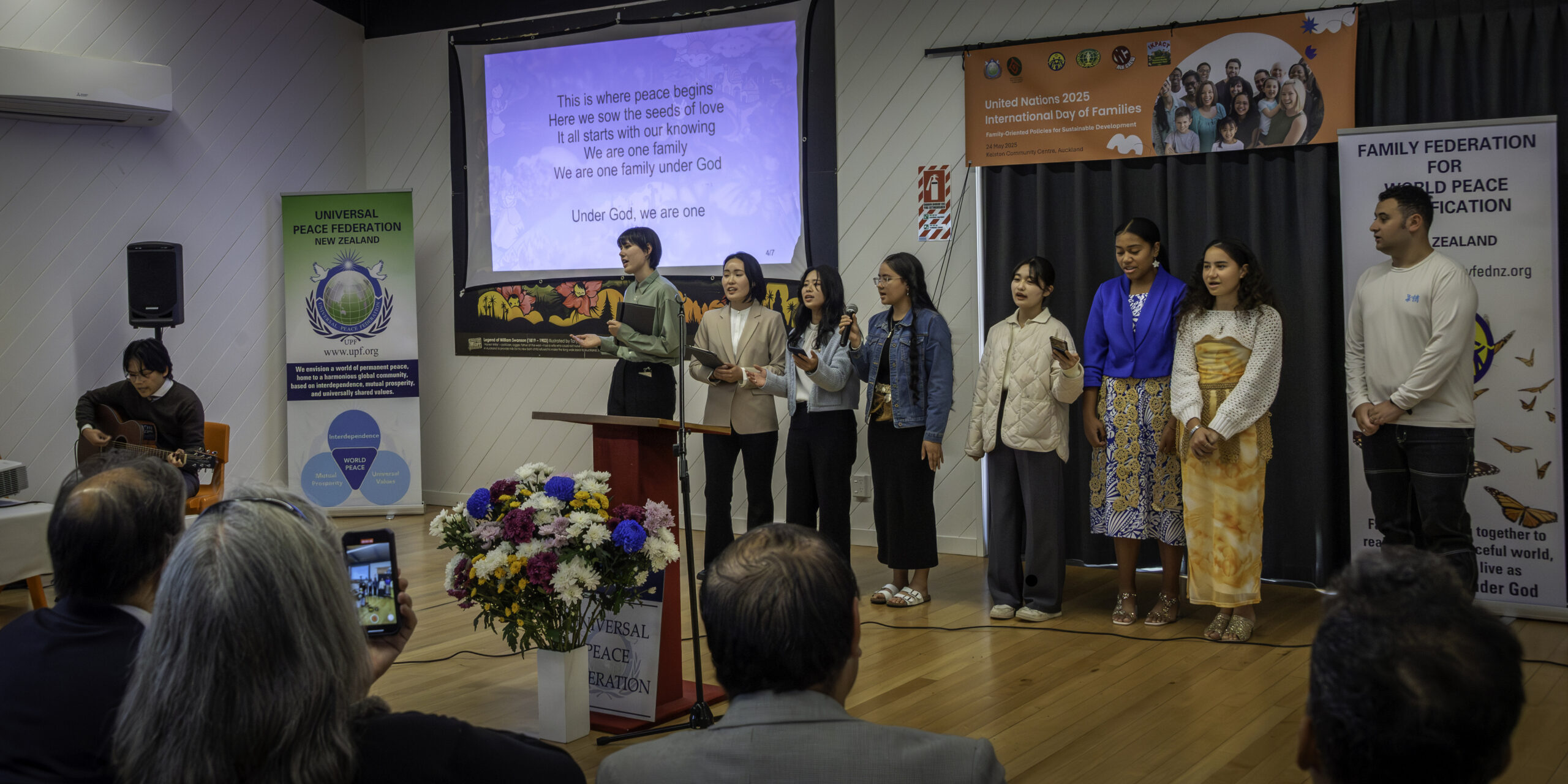
    On Saturday 24 May 2025, the Kelston Community Centre — Te Pae o Kura, Hikurangi in West Auckland became the site of UPF New Zealand’s annual commemoration of the United Nations International Day of Families. Around 60 people attended — drawn from across Auckland’s diverse faith and community networks — for an afternoon centred on the 2025 UN theme: “Family-oriented Policies for Sustainable Development.”

    The choice of Kelston as the venue reflected UPF New Zealand’s ongoing commitment to taking its events into different parts of the city — meeting people where they are, rather than always drawing them to a central location. West Auckland’s vibrant multicultural community was a fitting setting for an event that celebrates the family as the most universal of human institutions.

    Opening in the Spirit of Aotearoa

    The event opened with a prayer by Apostle Shannon Leilua of the Ratana Church — grounding the afternoon’s gathering in the spiritual values of Aotearoa and the Māori tradition of beginning communal occasions with karakia. It was a fitting start: the Ratana Church, rooted in the prophetic faith of New Zealand’s tangata whenua, has been a consistent partner in UPF New Zealand’s work, lending its spiritual voice to events across the year.

    Geoffrey Fyers, Secretary General of UPF New Zealand, then delivered the UPF statement on the International Day of Families — articulating the organisation’s conviction that the family is not merely a social unit, but the primary institution through which human beings learn to love, to serve, and to belong.

    Family-oriented Policies for Sustainable Development

    The UN theme for 2025 resonated deeply with UPF New Zealand’s ongoing National Family Day Petition campaign — a campaign calling on the New Zealand Government to recognise 11 November as a dedicated national family day. The connection between family-oriented policy and sustainable development is, for UPF, a deeply held conviction: that a society which invests in strong families is investing in everything else worth building.

    Sustainable development, in this understanding, is not primarily a matter of economic growth or environmental management — though it includes both. It is, at its foundation, a matter of human flourishing: of communities where people are loved and nurtured from birth, where the next generation is raised with values of responsibility and care, and where the bonds of family extend outward into a society of genuine mutual support.

    Presentations

    The programme featured presentations from two distinguished community leaders:

    • Mrs. Anne Degia-Pala, QSM — a community leader recognised with the Queen’s Service Medal for her years of service to New Zealand communities, whose perspective on the role of strong families in community resilience carried the weight of lived experience
    • Mr. Kenji Watanabe — Chairman of UPF New Zealand, who spoke on the role of families in building peaceful communities and on UPF’s vision for a New Zealand that honours family as the foundation of national life

    Cultural Performances

    The afternoon was enriched by performances that reflected the cultural diversity of UPF New Zealand’s community:

    • IKPACT members Suresh Trivedi and Shashi — offering a musical contribution from the Indian Kiwi community that brought warmth and energy to the afternoon
    • A choral presentation by FFWPU Youth — young members of the Faith Federation singing together in a performance that embodied the event’s theme: that families nurture the next generation, and the next generation carries the values of peace forward

    A Community That Keeps Showing Up

    Around 60 people came to Kelston Community Centre on a Saturday afternoon in autumn. They came from different suburbs, different cultural backgrounds, and different faith traditions. They sat together, listened together, and were fed — literally and figuratively — by what they shared.

    UPF New Zealand is grateful to the Kelston Community Centre for hosting the event, to every presenter and performer who contributed, and to every person who made the journey to be there. The UN International Day of Families is observed every year on 15 May. Our commemoration came a week later, but it arrived with the same conviction: that families matter, that policies which support them matter, and that communities which gather to say so are doing something genuinely important.

  • National Family Day Petition: Relaunching the Campaign

    Eleven eleven. The date carries history in New Zealand — and in much of the world. At the eleventh hour of the eleventh day of the eleventh month in 1918, the guns of the First World War fell silent. Armistice Day has been remembered ever since as a day of gratitude, grief, and the stubborn human insistence on peace.

    For UPF New Zealand, 11 November holds an additional meaning — one that does not diminish the solemnity of remembrance, but deepens it. The organisation has spent years building the case that this date should become Aotearoa’s National Family Day: a day to affirm that the foundations of lasting peace are laid not in battlefields or peace conferences, but in the families where the next generation learns to love, to serve, and to live for others.

    In early 2025, UPF New Zealand officially relaunched the National Family Day Petition — with renewed energy, new outreach strategies, and a broader community campaign that invites all of Aotearoa to get involved.

    Why a National Family Day?

    The question deserves a direct answer. New Zealand already recognises a wide range of national commemorations and celebrations. What would a National Family Day add?

    UPF New Zealand’s answer is grounded in a conviction about the relationship between family strength and national wellbeing. Strong families produce resilient children, connected communities, and a society better able to navigate the pressures of a changing world. Conversely, family breakdown — whatever its causes — contributes to a cascade of social challenges: loneliness, educational disengagement, mental health struggles, and the erosion of the community bonds that hold us together in hard times.

    A National Family Day would not, by itself, build stronger families. But it would send a signal — a statement of national values — that families matter to New Zealand, that the work of building them is honoured, and that the Government and the community stand behind the men and women doing that work every day.

    As Chairman Kenji Watanabe has written, the proposed National Family Day reflects a vision for New Zealand grounded in four values that resonate deeply with both Māori and Pacific culture:

    • Whanaungatanga — strengthening bonds of relationship between people, across cultural and generational lines
    • Kaitiakitanga — caring responsibly for one another and for the natural world we share
    • Manaakitanga — supporting communities with dignity, generosity, and genuine hospitality
    • Kotahitanga — uniting across cultures, faiths, and backgrounds toward a shared purpose

    100 Days of Serving Community

    Alongside the petition relaunch, UPF New Zealand announced a complementary initiative: the “100 Days of Serving Community” campaign — a three-month programme inviting individuals, families, and organisations to take concrete actions of service in their own neighbourhoods and communities.

    The proposed activities are deliberately accessible:

    • Environmental clean-ups in local parks, coastlines, and public spaces
    • Supporting local food shelters, community centres, and social services
    • Organising family activities that bring communities together across cultural lines
    • Social media sharing with the theme: “Build a New Zealand that honours families”

    The 100 Days campaign reflects UPF New Zealand’s conviction that the petition is not merely a legal or political exercise — it is the visible tip of a much larger cultural project. The goal is not just a date on the calendar, but a shift in the values that shape how New Zealand thinks about family, community, and the common good.

    Signature Campaign

    The SNS National Family Day Signature Campaign launched in early 2025, with targeted outreach through social media, community organisations, and local leaders. UPF New Zealand is calling on like-minded politicians, community influencers, faith leaders, and everyday Kiwi families to lend their voices — and their signatures — to the cause.

    To sign the petition and add your voice, contact UPF New Zealand at secretariat@upfnz.org or attend one of our monthly community meetings at the Peace Embassy in Parnell, Auckland. Together, we can build a New Zealand that honours families — and in doing so, honour the deepest values of Aotearoa.

  • Youth and Family Peace Day 2024

    It is one thing to hold an event. It is another to hold it twice — and watch it grow. On Saturday 9 November 2024, the second annual Youth and Family Peace Day opened its doors at the Due Drop Events Centre in Manukau, South Auckland, and over 300 people came to be part of it.

    The venue was the same as the inaugural event in 2023 — a deliberate choice. Due Drop has become the home of Youth and Family Peace Day, and its familiar halls carried the memory of what had been built there a year earlier, even as the 2024 programme brought new energy, new partners, and a new theme: “Communities United for Fostering Peace, Strengthening Families, and Empowering Youth.”

    Opening the Day

    The opening programme began at 11:00 am in the main hall. The day started, as it had in 2023, with a karakia — this year offered by Tokorima Aperahama, Ratana Church youth representative, who has become a familiar and beloved presence at UPF New Zealand events. His family joined him in a hymn that grounded the morning in the spiritual values of Aotearoa.

    Ruth Cleaver, a senior member of UPF New Zealand and former President of the Auckland Interfaith Council, served as MC for the opening session — acknowledging the partner organisations whose presence filled the exhibition hall next door with information, resources, and community goodwill.

    Kenji Watanabe, Chairman of UPF New Zealand, and Geoffrey Fyers, Secretary General, delivered opening remarks and presented the Resolution of the National Family Day Petition — reaffirming the campaign’s call for the New Zealand Government to recognise 11 November as a dedicated national family day, and inviting the assembled community to add their voices to the movement.

    Distinguished Guests

    The event was again honoured by the presence of distinguished guests whose welcoming remarks lent the occasion civic weight and warmth:

    • Hon. Jenny Salesa, Member of Parliament — returning for her second consecutive Youth and Family Peace Day, her presence a sign of Parliament’s growing recognition of UPF New Zealand’s contribution to Auckland’s community life
    • Mr. Keu Mataroa, Consul General of the Cook Islands — representing the Pacific community’s stake in the values of family and peace that the event embodies
    • Mr. Joe Fatuleai, Stake President of Redoubt, The Church of Jesus Christ of Latter-day Saints — bringing the voice of one of South Auckland’s most active faith communities

    Keynote: The Family as the School of Love

    The keynote address was delivered by Greg Stone, Secretary General of UPF Oceania — returning to the Youth and Family Peace Day stage for the second year running. His keynote built on the theme he had introduced in 2023, deepening the community’s understanding of the relationship between family life and societal peace.

    Greg’s central message was one that his audiences find both challenging and liberating: “The family is not just the building block of society — it is the school where we learn to love, to forgive, and to live for others.”

    This is a claim with practical implications. If the family is where we learn to love — or fail to — then the health of families is not a private matter. It is the most public of all concerns, because every family that succeeds in raising children with the capacity to love and serve is making a contribution to the peace of the society those children will inhabit and lead.

    The Exhibition Hall: Resources for Real Life

    One of the most distinctive features of the 2024 Youth and Family Peace Day was the expanded exhibition hall, where faith groups, social service organisations, government institutions, and NGOs set up information tables offering practical resources on:

    • Healthy marriages and relationship skills
    • Parenting with purpose and positive family values
    • Youth leadership and character development
    • Interfaith cooperation and community belonging

    Partner organisations from across Auckland — spanning Pacific Island churches, South Asian community groups, mainstream social services, local government, and civil society — contributed information, performances, and presentations throughout the day. The exhibition hall was, in many ways, the most democratic part of the event: a space where visitors could wander at their own pace, pick up a resource that spoke to their situation, and have a conversation that might change something for them.

    A Growing Movement

    More than 300 people came to the Due Drop Events Centre on 9 November 2024. They came from different parts of Auckland, different cultural backgrounds, different faith traditions, and different generations. They stayed for different lengths of time and took away different things — but they all came.

    The steady growth of Youth and Family Peace Day — from 350+ across a full-day programme in 2023 to 300+ through a refined and deepened programme in 2024 — reflects not a decline, but a maturing: an event that has found its form and is growing in depth as it grows in reach. The third annual Youth and Family Peace Day is already being planned for November 2025, and UPF New Zealand is looking forward to welcoming even more families, young people, and community leaders to what has become one of Auckland’s most distinctive annual peace gatherings.

  • UN International Day of Families 2024

    On Saturday 25 May 2024, the auditorium of the Te Tuhi Art Centre in Pakuranga, East Auckland, became a room full of generations. Grandparents and grandchildren. Faith leaders and youth workers. Musicians from the Far North and dancers from the Chinese community. More than 60 people of all ages and backgrounds had come to celebrate the United Nations International Day of Families — and the atmosphere, from the moment the programme began, was one of genuine joy.

    UPF New Zealand’s annual commemoration of this day has become one of the most eagerly anticipated events in the organisation’s calendar — a gathering that manages to be simultaneously formal (with distinguished speakers and structured programming) and deeply human (with music, laughter, and the kind of connection that happens when people from very different worlds discover how much they have in common).

    Opening the Celebration

    MC Garpreet Singh opened the programme with warmth and good humour, before Geoffrey Fyers, Secretary General of UPF New Zealand, delivered the UPF statement on the significance of the International Day of Families. Geoffrey’s remarks situated the afternoon’s celebration in the broader global context — the United Nations’ recognition that families are the foundational unit of sustainable human development, and that policies which support strong family life are among the most important investments any society can make.

    Interfaith Panel: What Does Faith Say About Family?

    The intellectual and spiritual centrepiece of the programme was a thoughtful interfaith panel discussion that brought together four voices from four faith traditions — each reflecting on what their community believes about the family, its sacred role, and its place in the project of building a more peaceful world:

    • Dr. Zain Ali — Honorary Academic at the University of Auckland, who offered the Muslim perspective on family as a trust from God and a foundation of moral formation
    • Mr. Levi Singsam — from The Church of Jesus Christ of Latter-day Saints, sharing the LDS conviction that families are central to God’s eternal plan
    • Miss Avneet Singh — Sikh Youth representative, offering the Sikh understanding of family as the first community in which we practice the values of equality, service, and devotion
    • Mr. Amon Watanabe — of the Youth Service Programme, FFWPU, sharing a young person’s perspective on family as the school of love

    The panel was not a debate. It was a conversation — and one that revealed, beneath the genuine differences of theology and tradition, a shared conviction that the family is something sacred, something worth protecting, and something that gives meaning to the lives built within it.

    Cultural Performances

    Between the speeches and the panel, the afternoon was alive with music and performance:

    • The Ratana whanau brass band — musicians who had made the journey from Kaitaia, in the Far North, to be part of the celebration. Their presence, and the distance they had travelled, said something about how much this gathering meant to those who came.
    • An LDS Church Youth Duet — a moving musical presentation from young members of the faith community in Manukau
    • The Botany Down Chinese Association — a graceful representation of Chinese classical music and dance, bringing another layer of cultural richness to the afternoon
    • Japanese Youth Volunteers — who presented two short video presentations on family and service, offering a window into how young people across the Pacific understand their responsibility to both

    Refreshments and Community Connection

    Following the programme, attendees gathered for refreshments and informal conversation — the part of the afternoon that is, in many ways, the most important. The bonds formed over shared food and honest conversation are the actual fabric of the community UPF New Zealand is working to build. People who came as strangers left as something closer to neighbours.

    The UN International Day of Families is observed globally on 15 May each year. UPF New Zealand’s celebration came a week later, but arrived no less wholeheartedly. The conviction animating it was simple and ancient: the family is not merely a social arrangement. It is the first place where we learn to love — and in that learning, the beginning of everything else worth building.

  • Youth and Family Peace Day 2023

    It had been three years in the making. Since October 2020, UPF New Zealand had been developing the vision for an event that could bring together Auckland’s multicultural community around a single, powerful conviction: that lasting peace in society begins with strong, loving families. On Saturday 11 November 2023, that vision became reality.

    The inaugural Youth and Family Peace Day was held at the Due Drop Events Centre in Manukau — one of Auckland’s most iconic venues, chosen deliberately for its capacity to welcome a broad and diverse community. From 11:00 am to 5:00 pm, more than 350 people came and went throughout the day, making it the most significant public event in UPF New Zealand’s history to that point.

    The date — 11 November — was itself intentional. Known internationally as Armistice Day, it is a day of remembrance for those lost to war. For UPF New Zealand, it carries a second meaning: as the proposed date for a national Family Day in New Zealand — a day to affirm that the prevention of war begins not in diplomacy, but in the family, where the next generation learns to love and to live for others.

    A Vision Three Years in the Making

    The purpose of Youth and Family Peace Day, as articulated by the organising committee, was threefold: to create a pro-family and marriage culture in New Zealand; to teach young people a loyal and sincere heart; and to share practical steps toward building what UPF calls “blessed families” — families grounded in love, commitment, and service — in partnership with like-minded organisations across the community.

    The three-year development period had allowed UPF New Zealand to build the partnerships, the programme architecture, and the community relationships necessary to make the event something genuinely participatory, rather than merely a platform for speeches.

    Opening the Day

    The opening programme began at 11:00 am in the main hall. A karakia led by Tokorima Aperahama, a Ratana Church youth representative, opened the gathering in the spiritual tradition of Aotearoa — grounding the day’s celebration in a deep respect for the land and for the Creator who made us one family.

    Opening remarks were delivered by Kenji Watanabe, Chairman of UPF New Zealand, and Geoffrey Fyers, Secretary General. The resolution of the National Family Day Petition — UPF New Zealand’s ongoing campaign to establish 11 November as a dedicated national family day — was presented as part of the formal opening.

    Distinguished guests who brought welcoming remarks to the occasion included:

    • Hon. Jenny Salesa — Member of Parliament, New Zealand
    • Keu Mataroa — Consul General of the Cook Islands
    • Joe Fatuleai — Stake President of Redoubt, The Church of Jesus Christ of Latter-day Saints

    Keynote: Peace Begins at Home

    The keynote address was delivered by Greg Stone, Secretary General of UPF Oceania — a speaker whose long experience in the region lent his words both authority and warmth. His message was the thread that ran through the entire day: “Peace building starts with family building, expanding outward to peace in the society and the nation.”

    It is a deceptively simple claim. But in a world that tends to address peace through the lens of geopolitics, diplomacy, and institutional power, it represents a genuinely different starting point — one that places responsibility for the condition of the world not primarily with governments or international bodies, but with each family, and each individual within it.

    Three Pillars of the Programme

    The full-day programme was structured around three core components, each running in parallel throughout the event:

    Cultural Performances — showcasing the extraordinary diversity of New Zealand’s multicultural community. Performers from Pacific Island, Asian, and New Zealand communities filled the stage with music, dance, and artistic expression that celebrated the richness of Aotearoa’s people.

    Youth and Family Cultural Presentations — young people taking the stage to share their own vision for a peaceful future. These presentations were among the most powerful moments of the day — not polished speeches, but genuine expressions from the next generation about what they believe, what they hope for, and what kind of world they want to build.

    Marriage and Family Culture Presentations — exploring the practical and philosophical foundations of strong family life. Partner organisations from faith communities, social services, and civil society presented resources, insights, and personal stories about marriage, parenting, and the daily work of building a family that blesses those around it.

    A Day That Exceeded All Expectations

    By any measure, the inaugural Youth and Family Peace Day exceeded expectations. More than 350 people — a number that would have seemed ambitious in planning meetings — came to Due Drop Events Centre and stayed, moved through the programme, connected with exhibitors, and left with something they had not had before: a sense of being part of a community with a shared vision.

    UPF New Zealand’s firm conviction — that the four pillars of family love (children’s love toward parents, siblings’ love, conjugal love, and parental love) are the foundation of a peaceful society — had found, in this event, its most vivid public expression. And in the days and weeks that followed, the momentum of the National Family Day Petition continued to grow.

    Armistice Day, 11 November 2023, had become something new for UPF New Zealand: the beginning of an annual tradition. Youth and Family Peace Day would return in 2024 — and the community that had gathered for the first time in Manukau would keep growing.

  • UN International Day of Families 2023

    On the evening of Saturday 17 June 2023, the auditorium of the Te Tuhi Arts and Cultural Centre in Pakuranga, East Auckland, filled with the sound of music, laughter, and the warmth of genuine community. UPF New Zealand’s commemoration of the United Nations International Day of Families had begun — and despite the traffic congestion that delayed many attendees, around 80 people eventually settled in to share an evening that would leave a lasting impression.

    The event was co-sponsored by UPF New Zealand alongside three partner organisations: the Family Federation for World Peace and Unification (FFWPU), the Women’s Federation for World Peace (WFWP), and the Indian Kiwis Positive Aging Charitable Trust (IKPACT) — a coalition that itself reflected the spirit of the evening: diverse in background, united in purpose.

    The UN Theme: Demographic Trends and Families

    The United Nations chose “Demographic Trends and Families” as the theme for the International Day of Families 2023 — a recognition of the profound ways in which shifting population patterns are reshaping the conditions in which families form, grow, and endure. Falling birth rates, ageing populations, increasing mobility, and changing family structures are among the megatrends demanding new thinking from governments and communities alike.

    UPF New Zealand’s approach to this theme was characteristic: to focus not only on the policy dimensions of demographic change, but on the human heart of the matter — the question of what makes families strong, and how communities can nurture that strength.

    Opening the Evening

    Geoffrey Fyers, Secretary General of UPF New Zealand, welcomed the gathering with his trademark warmth, before opening remarks from Kenji Watanabe, Chairman of UPF New Zealand and FFWPU, and community leader Mr. Harinder Pal Singh Luthera, who brought a spirit of civic dignity to the occasion.

    The keynote was delivered by Ross Robertson — former Deputy Speaker of the New Zealand House of Representatives and a long-serving UPF Ambassador for Peace. Ross spoke on the positive influence of family lineage, of positivity, and of discipline. His message was one that transcended cultural background: that the stories we carry from our families — the examples set by parents and grandparents, the values passed down through generations — are among the most powerful forces shaping who we become. The audience, drawn from many different cultural traditions, nodded in recognition of a truth that is truly universal.

    Ideal Family Awards

    One of the most moving moments of the evening was the Ideal Family Award ceremony — a celebration of families who have been acknowledged by their communities for outstanding service, commitment, and love. This year’s recipients were:

    • Mr. Harjit Singh and Mrs. Tajinder Kaur
    • Mr. and Mrs. Taore
    • Mr. and Mrs. Pahuja

    Each family received their award to warm applause — recognition not of wealth or status, but of the quiet, daily work of building a family that blesses those around it.

    Peace Marriage Blessing Ceremony

    Following the awards, participants were introduced to the Peace Marriage Blessing Ceremony — an affirmation of the sanctity of the marital covenant and the vision of the family as the school of love. Couples in attendance joined together in a shared commitment to build families grounded in love, fidelity, and service to others. For many who participated, it was a moment of genuine renewal — a chance to reconnect with the vows and values at the heart of their family life.

    A Celebration of Culture

    Between the speeches and ceremonies, the programme was enriched by a series of cultural performances that brought the diversity of Auckland’s communities vividly to life:

    • Ms. Sneh offered a beautiful Indian song celebrating family and togetherness
    • Mrs. Lily Yao’s Chinese dance group performed with grace and precision, showcasing the elegance of Chinese classical dance
    • Mr. Angelo Bergantinos and his song partner delivered a moving congratulatory performance that spoke of the joy of commitment
    • The Tongan volunteers’ choir brought the house alive with a rousing choral performance that filled the auditorium

    Refreshments and Fellowship

    The evening drew to a close around 7:30 pm, with refreshments shared among participants who were in no hurry to leave. The bonds formed over shared food and shared values are, in many ways, the real work of an evening like this — the moments where people from different faiths and cultures find themselves in genuine conversation, discovering more common ground than division.

    The UN International Day of Families is observed each year on 15 May. UPF New Zealand’s June commemoration was a little later in the calendar, but no less sincere — a community gathering that demonstrated, in miniature, the kind of society we are all working to build: one that holds the family as the foundation of everything good.

  • UN International Day of Families 2022

    There is something irreplaceable about being in the same room. After two full years of online gatherings, postponements, and the particular loneliness of a world separated by a pandemic, UPF New Zealand’s commemoration of the United Nations International Day of Families 2022 carried an emotional weight that went well beyond its programme.

    Held on Saturday 21 May 2022 at Mangere Memorial Hall in South Auckland, the event was co-hosted by UPF New Zealand, FFWPU New Zealand, and WFWP New Zealand — the first major in-person public gathering for the organisation since COVID-19 restrictions took hold in 2020. Around 80 people attended, including key community leaders from across Auckland.

    Welcome Back

    The MC for the occasion was Ruth Cleaver, a long-serving UPF Ambassador for Peace and former President of the Auckland Interfaith Council, whose warm presence helped set the tone for a reunion as much as a commemoration.

    Opening remarks were delivered by Rev. Kenji Watanabe (Chairman, UPF New Zealand and FFWPU), Geoffrey Fyers (Secretary General, UPF New Zealand), and Matapa Shelly (President, WFWP New Zealand) — each offering a reflection on what it means to gather again as a community, and what that gathering itself says about the resilience of the values we hold in common.

    The event’s theme aligned with the United Nations’ designation for 2022: “The Role of Families in Creating a Peaceful Society.” In a world still recovering from the social disruptions of the pandemic — and watching with grief as war returned to Europe — that theme felt anything but abstract.

    Keynote: Ross Robertson on Family as Foundation

    The keynote address was delivered by Ross Robertson — a four-time Deputy Speaker of the New Zealand House of Representatives and Member of Parliament from 1987 to 2014, and a long-standing UPF Ambassador for Peace.

    Ross spoke with characteristic directness and warmth on the theme of family values and the power of parental role modelling. His central message resonated deeply with the audience: that no child is born with a set of values — they learn them from family and friends. As adults, he argued, we are role models whether we choose to be or not. Children look to us for leadership, guidance, and inspiration. The family, then, is not merely a social unit — it is the first and most influential school any of us will ever attend.

    Other notable speakers included HP Singh Luthera, a respected Sikh elder, and Raniera Pene, a Christian Youth Minister — each offering their own faith community’s perspective on the sacred role of family in human flourishing.

    Music and Culture

    Musical interludes brought colour and joy to the programme throughout the afternoon. The Peace Run Group contributed a performance reflecting the spirit of international peacebuilding through sport and community. Families from the Cook Islands community shared performances that brought the warmth and pride of Pacific family culture into the room — a reminder of the rich tapestry of cultures that make up South Auckland’s community life.

    Youth Heroes Award: Lani Alo

    One of the most memorable moments of the day was the presentation of the YSP Youth Heroes Award to Lani Alo, a talented Samoan musician whose work actively promotes family values and cultural pride through his music. The award was presented by Dohie Kim, YSP New Zealand Coordinator — recognising Lani’s contribution to a music culture that uplifts communities, strengthens family bonds, and gives young people something worth singing about.

    The award was met with genuine warmth from the audience. In a culture often saturated with entertainment that pulls individuals away from community and family, Lani Alo’s work was a counter-cultural act — and UPF New Zealand wanted to honour it as such.

    A Room Full of Hope

    The gathering concluded with everyone joining together in the song “Where Peace Begins: One Family Under God” — a fitting anthem for an afternoon that had embodied exactly what the lyrics described. Group photos were taken, refreshments were shared, and a good number of participants stayed long after the programme had formally ended, strengthening the bonds of community that had been stretched thin by two years of separation.

    One participant, moved by the occasion, wrote to the organisers afterwards: “Congratulations on what was a lovely event to witness, particularly the coming together of diverse voices and compassion for what is a symbolic and universal unit.”

    It was a quiet but powerful reminder of why UPF New Zealand does what it does — and of how much community matters, especially when the world has spent two years telling us to stay apart.